Trigonometry

Discussion
triangles, tirangles, tirnagles
Some stuff about triangles.
functions, functions, functions
Some stuff about functions.
Standard position diagram
Sine
Cosine
Tangent
Reciprocal functions
Cosecant
Secant
Cotangent
historical, historical, historical
Trigonometry starts with chords drawn on a circle [this part is incomplete], followed by other line segments drawn on a circle [this part is the least incomplete], and eventually ends with functions that are ratios [this part has yet to be started].
An arc of a circle looks like a bow (as in a bow and arrow). A straight line joining the ends of an arc looks like a bowstring. Another word for a string is a cord — a word with multiple meanings and spellings. The English word cord (without an h) refers to a string or rope, while the English word chord (with an h) refers to the straight line joining the ends of an arc. (The musical chord has a completely different origin.) The Greek astronomerHipparchus of Nicaeausually gets credit for inventing this term, along with the rest of trigonometry, sometime in the 2nd century BCE, but this is open to debate. No one person can be said to have invented trigonometry.
The Greek word for string is χορδη (khorde).
Ptolemy and the table of chords.
Sanskrit is a four thousand year old language that was once the common tongue of scholars in India, Pakistan, Bangladesh, Sri Lanka, Nepal, and beyond. Sanskrit is to the Indian subcontinent as Latin is to the European continent. Both languages were used to spread ideas and information across large geographic regions with great linguistic diversity. Both languages are often described as "dead". The only scholars still using Latin or Sanskrit are those that study original historical texts. No new scholarship is written in Sanskrit or Latin, but some is written about Sanskrit or Latin. Languages never really die, however, as dead languages are the foundation for living ones.
The diagram below shows a variation of the standard position triangle that first appeared in Sanskrit astronomical texts some time before the 6th century.The most important of these is the सूर्यसिद्धान्त (Sūrya Siddhānta) or Theory of the Solar System, Sun Theory, Theory of the Sun, Treatise on the Sun.

The Sanskrit word for bow is चाप (cāpa). It is also the name given to an arc of a circle. The Sanskrit word for bowstring is ज्या (jyā). It is also the name given to a chord of a circle. At some point, Indian astronomers found that knowing the size of half a chord was more useful than knowing the size of a whole chord. Half a chord in Sanskrit is ज्यार्ध (jyārdha). This term became so popular that the modifier अर्ध (ardha) was dropped and the the word ज्या (jyā) or the synonym जीव (ji̅va) came to mean half a chord all by itself.
Arab scholars transliterated जीव (ji̅va) to جيب (jiba) adding a loan word to Arabic. European scholars didn't know this, so they read it as an already existing one. Since vowels are not really written in Arabic, the letters جيب might represent jiba (a loan word) or they might represent jaib (a preexisting word). The Latin scholars went with the latter. The Arabic word جيب (jaib) can be translated into Latin as sinus or into English as fold, as in the folds of a garment. The sinuses in your head are the folds of the deeper parts of your nasal cavity. Some regions on the Moon are called sinuses because they look like bays on a sea when viewed from the Earth. (The seas and bays on the Moon are regions of dark, smooth rock.)
The Latin word sinus was added to English as the loan word sine, not as the translated word fold. This transfer of mathematical knowledge from east to west across Eurasia was happening around the 11th century, at a time when European scholars spoke Latin, not English. (Even the English weren't speaking English that far back — at least, not in a form many of us would recognize today.)
| language | word | translation | |
|---|---|---|---|
| Greek | χορδη | (khorde) | bowstring |
| Sanskrit | ज्या | (jyā) | bowstring |
| जीव | (ji̅va) | bowstring | |
| Arabic | جيب | (jiba) | [loan word] |
| جيب | (jaib) | fold | |
| Latin | sinus | fold | |
| English | sine | [loan word] | |
In the old Sanskrit texts, half a chord was called ज्यार्ध (jyārdha) or just ज्या (jyā). The line that cut the chord was called कोटि ज्या (koṭi jyā) on one side and उत्क्रम ज्या (utkrama jyā) on the other. You could think of them as "complementary chord" and "contrary chord". When ज्या (jyā) in Sanskrit became sinus in Latin and then sine in English, कोटि ज्या (koṭi jyā) or कोज्या (kojyā) in Sanskrit became cosinus in Latin and then cosine in English. Sine and cosine have the same value for complementary angles, which makes them complementary functions or co-functions.
The leftover piece on the diagram above, उत्क्रम ज्या (utkrama jyā) the "contrary bowstring", became versus sinus in Latin and versed sine or versine in English. The versed part is related to the Latin word versus in the sense of being against something, but I don't really understand the logic.
There's a whole extended family of trig functions that never acquired anywhere near the same popularity as the co-functions, so I won't say anything more about them.
The diagram below shows the original triangle inside a circle from the Sūrya Siddhānta with a second triangle partly outside the circle that was added twelve centuries later. Well, the second triangle may have been added earlier than this, but the choice of names for the line segments is generally attributed to the Danish mathematician Thomas Fincke (1561–1656). The hypotenuse of this triangle touches the outside of the circle (the Latin word for touching is tangens) while the two legs cut across the circle (the Latin word for cutting is secans). This is the origin of the tangent and secant functions we know today, as well as their complementary functions: cotangent and cosecant.
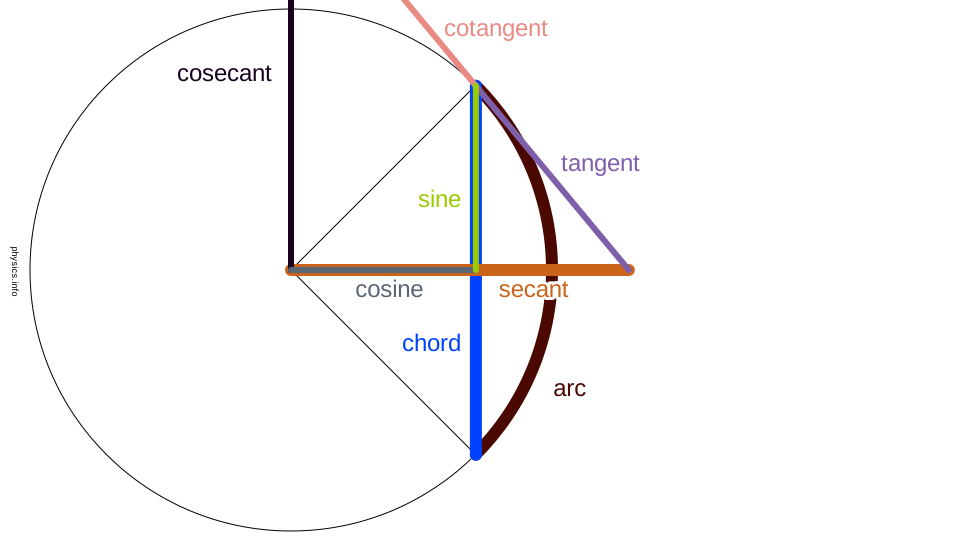
Side note: Greek is the only European language to devise its own names for all of the trig functions, but this was done in the 19th century when the modern state of Greece was emerging.
special triangles
Standardized tests love special triangles. One reason may be to help students solve problems quickly, especially if they aren't allowed to use calculators. The real reason is probably to speed up grading. Instructors can spot math and reasoning errors quicker. Memorizing the ratio of the sides and values of the angles in these triangles is often recommended.
- 45-45-90 triangle
- An isosceles right triangle. The base angles are both 45°. The two legs are equal in size. If we assume each leg has a length of 1 then, according to Pythagorean theorem, the hypotenuse has a length of √2.

45°, 45°, 90°
1:1:√2 - 30-60-90 triangle
- Half an equilateral triangle. Every equilateral triangle has three 60° angles. Assume the sides of the full triangle have a length of 2. Split the whole thing in half with a perpendicular bisector. This gives us one bisected angle of 30° and one bisected side with a length of 1. Using Pythagorean theorem, the leg that was the perpendicular bisector has a length of √3 and is opposite the 60° angle.

30°, 60°, 90°
1:√3:2 - 3-4-5 triangle
- The simplest Pythagorean triple gives us a triangle that's easy to work with. The math of the sides is simple. The size of the angles are best determined with a calculator.

37°, 53°, 90°
3:4:5