Electromagnetic Spectrum

Discussion
Introduction
A good, general sequence to remember is radio waves, microwaves, infrared, light, ultraviolet, x-rays, gamma rays

micropulsations
Less than 3 Hz is subradio, micropulsations, or another name.
- small, almost sinusoidal fluctuations of the geomagnetic field, with durations of seconds to minutes
radio waves
3 Hz–3 THz seems to be the agreed upon range of frequencies.
- oscillating, electric circuits
- discovered in 1888
- electric power transmission, analog audio signals, radio transmission, microwaves
- ELF, SLF, ULF, VLF, LF, MF, HF, VHF, UHF, SHF, EHF
- THF? Sure why not, even though it's verging on infrared.
- TLF? No, that's subradio.
| frequency band name |
frequency range |
ITU* band number |
wavelength band name |
wavelength range |
||||||
|---|---|---|---|---|---|---|---|---|---|---|
| 0.03 | – | 0.3 Hz | −1 | (10−1 Hz) | gigametric waves | 10 | – | 1 Gm | ||
| tremendously low frequency | (TLF) | 0.3 | – | 3 Hz | 0 | (100 Hz) | sub-gigametric waves | 1000 | – | 100 Mm |
| extremely low frequency | (ELF) | 3 | – | 30 Hz | 1 | (101 Hz) | super-megametric waves | 100 | – | 10 Mm |
| super low frequency | (SLF) | 30 | – | 300 Hz | 2 | (102 Hz) | megametric waves | 10 | – | 1 Mm |
| ultra low frequency | (ULF) | 300 | – | 3000 Hz | 3 | (103 Hz) | sub-megametric waves | 1000 | – | 100 km |
| very low frequency | (VLF) | 3 | – | 30 kHz | 4 | (104 Hz) | super-kilometric waves | 100 | – | 10 km |
| low frequency | (LF) | 30 | – | 300 kHz | 5 | (105 Hz) | kilometric waves | 10 | – | 1 km |
| medium frequency | (MF) | 300 | – | 3000 kHz | 6 | (106 Hz) | hectometric waves | 1000 | – | 100 m |
| high frequency | (HF) | 3 | – | 30 MHz | 7 | (107 Hz) | decametric waves | 100 | – | 10 m |
| very high frequency | (VHF) | 30 | – | 300 MHz | 8 | (108 Hz) | metric waves | 10 | – | 1 m |
| ultra high frequency | (UHF) | 300 | – | 3000 MHz | 9 | (109 Hz) | decimetric waves | 1000 | – | 100 mm |
| super high frequency | (SHF) | 3 | – | 30 GHz | 10 | (1010 Hz) | centimetric waves | 100 | – | 10 mm |
| extremely high frequency | (EHF) | 30 | – | 300 GHz | 11 | (1011 Hz) | millimetric waves | 10 | – | 1 mm |
| tremendously high frequency | (THF) | 300 | – | 3000 GHz | 12 | (1012 Hz) | sub-millimetric waves | 1000 | – | 100 μm |
| 3 | – | 30 THz | 13 | (1013 Hz) | super-micrometric waves | 100 | – | 10 μm | ||
| 30 | – | 300 THz | 14 | (1014 Hz) | micrometric waves | 10 | – | 1 μm | ||
| 300 | – | 3000 THz | 15 | (1015 Hz) | sub-micrometric waves | 1000 | – | 100 nm | ||
microwaves
Short (less than a meter) to teeny tiny (but not less than a tenth of a millimeter) wavelength radio waves. The high frequency side of the radio spectrum 0.3–3,000 GHz. Where the microwaves end and infrared begins is open to some debate however.
- rotating polar molecules
- cavity resonator magnetron
- cosmic background radiation
- radio detection and ranging (radar)
- microwave oven

Text
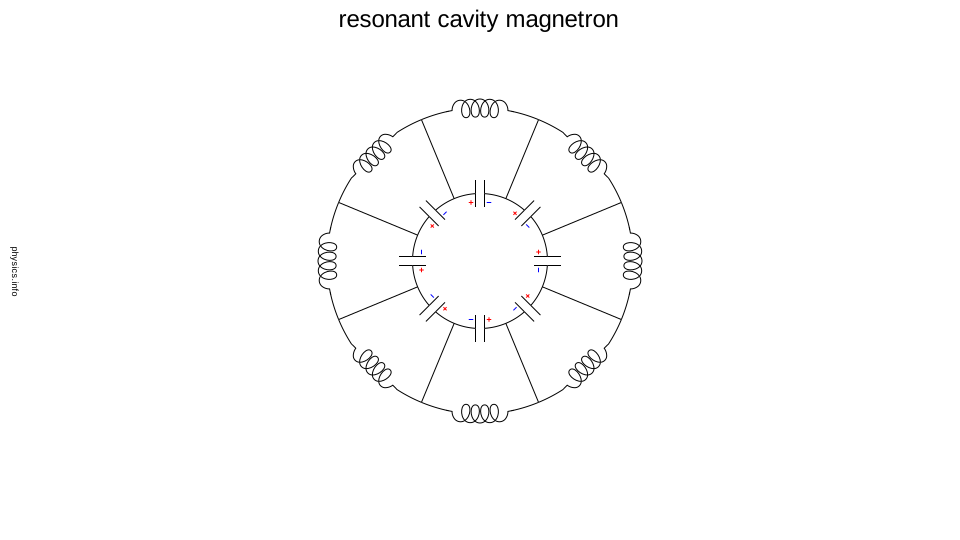
Equivalent Circuit Diagram
Diagram from Percy Spencer's 1945 US patent for the microwave oven. Note the popcorn kernel labeled "Food to be Cooked".
| frequency range (GHz) | ||||||||||
|---|---|---|---|---|---|---|---|---|---|---|
| band name | IEEE1 | ITU2 | ISO3 | |||||||
| HF | high frequency | 0.003 | – | 0.030 | ||||||
| VHF | very high frequency | 0.03 | – | 0.30 | 0.138 0.216 0.223 |
– – – |
0.144 0.225 0.230 |
|||
| P | previous | 0.216 | – | 0.450 | 0.225 | – | 0.390 | |||
| UHF | ultra high frequency | 0.3 | – | 1.0 | 0.420 0.890 |
– – |
0.450 0.942 |
|||
| L | long | 1 | – | 2 | 1.215 1.525 |
– – |
1.400 1.710* |
0.39 | – | 1.55 |
| S | short | 2 | – | 4 | 2.300 2.500 2.700 |
– – – |
2.500 2.690* 3.700§ |
1.55 | – | 5.20 |
| C | compromise | 4 | – | 8 | 3.400 4.200 4.500 5.250 5.850 |
– – – – – |
4.200* 4.400 4.800* 5.925¶ 7.075* |
3.9 | – | 6.2 |
| X | crosshair | 08 | – | 12 | 8.500 | – | 10.68 | 005.2 | – | 10.90 |
| uKu | kurze‡ under | 12 | – | 18 | 10.70 13.40 14.00 15.40 |
– – – – |
13.25* 14.00 14.50* 17.70 |
|||
| K | kurze‡ | 18 | – | 27 | 17.70 24.05 24.65 |
– – – |
20.20* 24.25 24.75† |
10.9 | – | 36.0 |
| aKa | kurze‡ above | 27 | – | 40 | 27.50 33.40 |
– – |
30.00* 36.00 |
|||
| Q | 36 | – | 46 | |||||||
| V | 40 | – | 75 | 37.50 47.20 59.00 |
– – – |
42.50* 50.20* 64.00† |
46 | – | 56 | |
| W | 075 | – | 110 | 076.0 092.0 |
– – |
081.0† 100.0† |
056 | – | 100 | |
| mm | millimeter | 110 | – | 300 | 136.0 151.5 231.0 238.0 |
– – – – |
148.5† 155.5† 235.0† 248.0† |
|||
| THz | terahertz | 0300 | – | 1000 | 0300 | – | 3000† | |||
The traditional radar band names (L, S, C, X, Ku, K and Ka) originated during World War II as a secret code so scientists and engineers could talk about classified frequencies without divulging them. After the war the codes were declassified and the Q, V, W, and millimeter (mm) bands were added. The designations were eventually adopted by the Institute of Electrical and Electronics Engineers (IEEE — read as "I triple E") in the United States, and internationally by the International Telecommunication Union (ITU) and International Organization for Standardization (ISO).
infrared (a.k.a. "infrared light")
Literally "below" red. So anything shorter than red light (700–800 nm or ~400 THz), but not so short that you could build an oscillating circuit transmitter; i.e., a radio (1 mm or 3 THz). Actually, the longer wavelengths kind of drip over into microwaves.
- a pigment of the imagination
- radiation in the wavelength range 0.7 micrometer to 1 millimeter
- Infrared radiation (IR radiation) is em radiation for which the wavelengths are longer than those for visible radiation.
- For infrared radiation, the range between 780 nm and 1 mm is commonly subdivided into:
- IR-A: 780 nm to 1400 nm (0.78 μm to 1.4 μm)
- IR-B: 1.4 μm to 3.0 μm
- IR-C: 3 μm to 1,000 μm (0.003 mm to 1 mm)
- A precise border between visible radiation and infrared radiation cannot be defined because visual sensation at wavelengths greater than 780 nm can be experienced.
- In some applications the infrared spectrum has also been divided into "near", "middle", and "far" infrared; however, the borders necessarily vary with the application.
- discovered in 1800 by William Herschel (1738–1822) in the Sun's spectrum
- vibrating molecules
- atoms in solids vibrating about their lattice positions
- Humans usually perceive infrared radiation as heat.
- "not so hot" stuff
- thermal infrared radiation which has a wavelength between 30 μm and 200 μm. At normal environmental temperatures objects emit infrared between these wavelengths; hotter objects, such as fires, emit infrared at wavelengths shorter than thermal infrared.
- far-infrared a.k.a. terahertz waves
- terahertz radiation is estimated to account for 98% of all the photons that have been emitted since the big bang — P.H. Siegel, IEEE Transactions Microwave Theory Technology, 30, 910 (2002)
- 0.8–4 THz known as the terahertz gap, frequencies just below the reach of optical technologies and just above the reach of electronics
- mid-infrared Infrared radiation which has a wavelength between 5 μm and 30 μm
- near-infrared Infrared radiation which has a wavelength between 0.7 μm and 5 μm. Near-infrared is further subdivided into
- short-wave infrared (1 μm-5 μm).
- very-near infrared (0.7 μm-1 μm) Photographic films respond to wavelengths between 0.7 μm and 1.0 μm, hence very-near infrared is also known as photographic infrared. Glass is opaque to infrared radiation of wavelength longer than 2 μm and other materials, such as germanium, quartz, and polyethylene, have to be used to make lenses and prisms.
- "not so excited" electrons in atoms, molecules, and semiconductors
light (a.k.a."visible light")
Roughly 400–700 nm
- Light is radiation that is considered from the point of view of its ability to excite the visual system. The term "light" is sometimes used for optical radiation extending outside the visible range, but this usage is not recommended.
- "Visible radiation is capable of causing a visual sensation directly. There are no precise limits for the spectral range of visible radiation since they depend upon the amount of radiant flux reaching the retina and the responsivity of the observer. The lower limit is generally taken between 360 nm and 400 nm and the upper limit between 760 nm and 830 nm."
- a good, general sequence to remember is red, orange, yellow, green, blue, violet
- NOTE Purple is a hue which is not represented in the hues of the spectrum.
- "hot" stuff; incandescent
- "excited" electrons in atoms, molecules, and semiconductors; luminescent
ultraviolet (a.k.a. "ultraviolet light")
Literally "beyond" violet. So shorter than say 400 nm. Somewhere around there. Down to as short as 0.1 nm in some fields of science. (Ultraviolet and x-rays overlap.) Whether you label it ultraviolet or x-rays depends on the application.
- a pigment of the imagination
- "very hot" stuff
- "very excited" electrons in in atoms, molecules, and (are we there yet?) semiconductors
- discovered in 1801
- moderately energetic, accelerated electric charges (just under ten to thousands of electronvolts)
- classification I (ISO 21348)
- NUV, near ultraviolet (300–400 nm)
- MUV, middle ultraviolet (200–300 nm)
"The ozone layer of the atmosphere absorbs all wavelengths shorter than 290 nm."
"UV solar irradiances below 300 nm are completely absorbed by molecular oxygen and ozone." - FUV, far ultraviolet (122–200 nm)
- EUV, extreme ultraviolet (10–121 nm)
It should really be XUV since the word extreme is alliterative with the letter x — as in x-rays. Extreme ultraviolet radiation is verging on x-rays. - VUV, vacuum ultraviolet (10–200 nm)
Absorption by the oxygen in air makes the use of evacuated apparatus essential when working with FUV and EUV radiation.
- radiation in the wavelength range 100 nm to 400 nm
- Ultraviolet radiation (UV radiation) is optical radiation for which the wavelengths are shorter than those for visible radiation
- The range between 100 nm and 400 nm is commonly subdivided into:
- UV-A: 315 nm to 400 nm
- UV-B: 280 nm to 315 nm
- UV-C: 100 nm to 280 nm
- A precise border between "ultraviolet radiation" and "visible radiation" cannot be defined, because visual sensation at wavelengths shorter than 400 nm is noted for very bright sources.
- In some applications the ultraviolet spectrum has also been divided into "far," "vacuum," and "near" ultraviolet; however, the borders necessarily vary with the application (e.g. in meteorology, optical design, photochemistry, thermal physics).
- classification II (ISO 21348), according to its effects on the skin, Photobiological designations of the Commission Internationale de l'Eclairage (International Commission on Illumination), cited in IARC 1992.
- UVA (315–400 nm)
UVA is the dominant tanning ray and plays a major part in skin aging and wrinkling (photo-aging). "Most of us are exposed to large amounts of UVA throughout our lifetime. UVA rays account for up to 95 percent of the UV radiation reaching the Earth's surface. Although they are less intense than UVB, UVA rays are 30 to 50 times more prevalent. They are present with relatively equal intensity during all daylight hours throughout the year, and can penetrate clouds and glass." Black light. Maximum Permissible Exposure (MPE) 1,000 μW/cm2 8 hours. Suntans are related to UVA exposure. They do not cause sunburns because of their lower energy than UVB or UVC. Since UVA penetrate deeper they damage collagen fibers and destroy vitamin A. Some skin problems (psoriasis, for example) can be treated with UV light. For a treatment known as PUVA, a drug called a psoriases is given first. The drug collects in the skin and makes it more sensitive to UV. Then the patient is treated with UVA radiation. Another treatment option is the use of UVB alone (without a drug). - UVB (280–315 nm)
The tanning and cancer-causing rays. Erythemal — the chief cause of skin reddening and sunburn. MPE 500 μW/cm2 1 minute. Photokeratitis, Welder's Flash, or Arc Eye is literally burning of the cornea by intense exposure to UVB. Cataracts, pterygia, pinguecula. One positive affect of moderate doses of UVB is that in induces the production of vitamin D and vitamin K. Used clinically in the treatment of certain skin complaints (such as psoriasis) and to induce vitamin D formation in patients that are deficient. Acne, psoriasis, neonatal high levels of bilirubin, and daylight deprivation depression are some of the ailments treated with UVB. - UVC (100–280 nm)
This radiation band is entirely absorbed by the ozone layer in the atmosphere and does not reach the Earth's surface. Germicidal. MPE 100 μW/cm2 1 minute.
- UVA (315–400 nm)
- Photodermatol Photoimmunol Photomed 2002: 18: 68–74
- The notion to divide the ultraviolet spectrum into different spectral regions was first put forward at the Copenhagen meeting of the Second International Congress on Light held during August 1932. It was recommended that three spectral regions be defined as follows:
- UVA: 400–315 nm
- UVB: 315–280 nm
- UVC: 280–100 nm
- The subdivisions are arbitrary and differ somewhat depending on the discipline involved. Environmental and dermatological photobiologists normally define the wavelength regions as:
- UVA: 400–320 nm
- UVB: 320–290 nm
- UVC: 290–200 nm
- The division between UVB and UVC is chosen as 290 nm since UV radiation at shorter wavelengths is unlikely to be present in terrestrial sunlight, except at high altitudes. The choice of 320 nm as the division between UVB and UVA is perhaps more arbitrary. Although radiation at wavelengths shorter than 320 nm is generally more photobiologically active than longer wavelength UV, advances in molecular photobiology indicate that a subdivision at 330–340 nm may be more appropriate and for this reason the UVA region has, more recently, been divided into
- UVAI (340–400 nm) and
- UVAII (320–340 nm).
- The notion to divide the ultraviolet spectrum into different spectral regions was first put forward at the Copenhagen meeting of the Second International Congress on Light held during August 1932. It was recommended that three spectral regions be defined as follows:
- Mnemonic
- UV-A aging (97% of UV at surface)
- UV-B burning (3% of UV at surface)
- UV-C can't pass throught the atmosphere (0% of UV at surface)
x-rays
The range of wavelengths here is 10−8 m down to 10−12 m, with the long end overlapping the ultraviolet and the short end overlapping gamma rays,
- discovered in 1895
- energetic, accelerated electric charges (thousands to millions of electronvolts)
- bremsstrahlung — braking acceleration
- synchrotron — centripetal acceleration
- extreme electron transitions to replace electrons dislodged from deep shells near the nucleus (bombardment of atoms by high-quantum-energy particles)
- soft x-rays, hard x-rays
gamma rays
Everything shorter than 10−11 meter. How much shorter? Good question.
- discovered in 1900
- very energetic, accelerated electric charges (millions to billions of electronvolts and higher)
- usually extraterrestrial in origin. High-energy particles that fall on the Earth from space. Primary cosmic rays consist of nuclei of the most abundant elements, with protons (hydrogen nuclei) forming by far the highest proportion; electrons, positrons, neutrinos, and gamma ray photons are also present. The particle energies range from 10−11 J to 101 J (108 to 1020 eV) and as they enter the Earth's atmosphere they collide with oxygen and nitrogen nuclei producing secondary cosmic rays. The secondary rays consist of elementary particles and gamma -ray photons. A single high-energy primary particle can produce a large shower of secondary particles. The sources of the primary radiation are not all known, although the Sun is believed to be the principal source of particles with energies up to about 1010 eV. It is believed that all particles with energies of less than 1018 eV originate within the Galaxy.
- nuclear reactions; excited nuclei returning to their ground state
- usually terrestrial in origin