Given an object oscillating horizontally in simple harmonic motion, where in the course of its motion are the magnitudes of the following quantities equal to zero? Where are they equal to their maximum value?
acceleration
elastic potential energy
kinetic energy
net force
speed
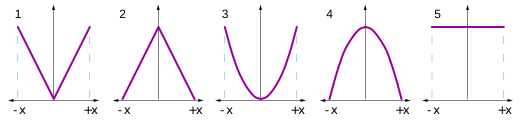
Given an object oscillating horizontally in simple harmonic motion, which graph of energy vs. displacement shown below…
best represents…
the total energy of the object-spring system?
the kinetic energy of the object?
the potential energy of the spring?
Explain your reasoning.
numerical
A 1.0 kg cube oscillates horizontally on the end of a spring like the one shown below. The extreme displacement of the mass as it oscillates is 0.10 m and its period of oscillation is 0.50 s.
Determine the spring constant.
After 27 periods, the cube comes to rest. Determine the energy dissipated by friction.
the number of oscillations of the Human Slingshot (it is not a whole number)
the time for the number of oscillations stated above
the mass of the passenger
the maximum displacement of the passenger from the equilibrium point
Using the values recored above, determine…
the spring constant of the two bungee cords combined
the maximum pulling force exerted by the ATV
the maximum acceleration of the passenger
the work done by the ATV
the maximum speed of the passenger
If the same person had another run on the Human Slingshot but was released halfway out, how would this affect the following quantities…
the period of oscillation
the maximum speed
statistical
exercise-spring.txt A mass (m) is attached to the bottom end of a vertically suspended spring removed from an exercise device. The mass is pulled down, stretching the spring, then released. The mass oscillates up and down and the period (T) is measured. The experiment is repeated, increasing the mass for each trial. The data collected in this experiment are written in the table in this tab delimited text file. Using your favorite data analysis software, determine…
the spring constant (k) of this spring
the period of the spring if a 4.896 kg mass was attached to the bottom
A group of students set up an inertial balance, loaded it with various known masses, set it oscillating, and measured the corresponding periods. Then they repeated the experiment with a series of items of unknown mass (basically, whatever they brought with them to lab that day).
inertial-balance-calibration.txt Derive an equation that relates mass to period for this inertial balance using the measurements taken in the first half of the experiment.
inertial-balance-unknowns.txt Apply the equation you just derived to the measurements taken in the second half of this experiment and determine the masses of the objects that the students brought with them to lab.
This balance consisted of a small lab cart placed on a horizontal track with two identical springs mounted on opposite ends. Determine…
the mass of the empty balance (the mass of the small lab cart) and…
the spring constant of the two springs. (Be careful with the units here. The masses were recorded in grams, but the spring constant should be stated in N/m and the newton is based on the kilogram.)