Summary
- The kinematic quantities of displacement, velocity, and acceleration can be described by all sorts of functions.
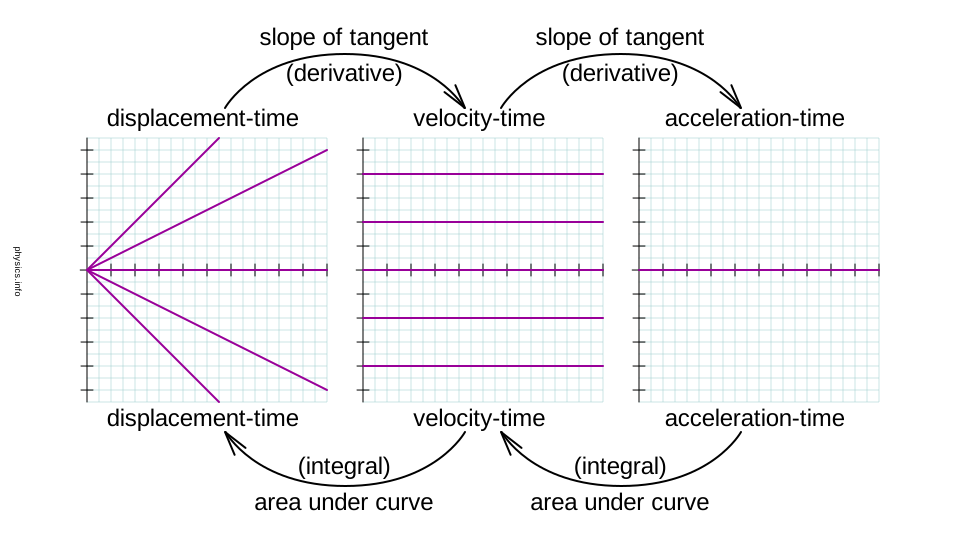
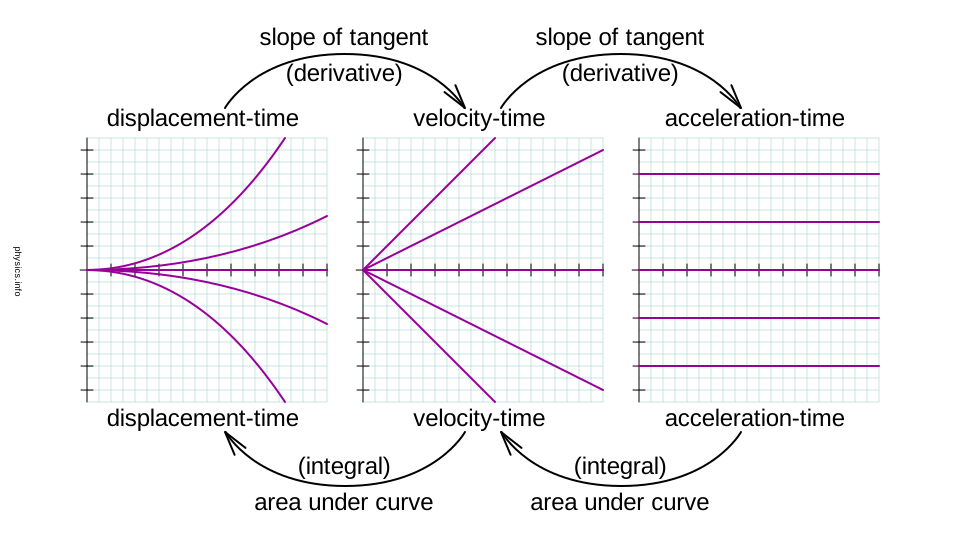
- The function describing one quantity can be transformed into functions describing the other two quantities.
- The procedure for doing so is either…
- differentiation (finding the derivative) or…
- The derivative of displacement with time is velocity.
- The derivative of velocity with time is acceleration.
- integration
(finding the integral).
- The integral of acceleration over time is velocity.
- The integral of velocity over time is displacement.
- The techniques of calculus can also be used to analyze functions — including those that describe motion.
- The first derivative of a function…
- is the instantaneous rate of change of the function.
- determines the slope of a line tangent to a graph of the function.
- equals zero at a local extrema (maximum or minimum) or a saddle point of the function.
- The second derivative of a function…
- is used to determine the direction of concavity of the graph of a function.
- The graph of a function is concave up if its second derivative is positive.
- The graph of a function is concave down if its second derivative is negative.
- An inflection point (the transition between two different concavities) occurs where the second derivative is zero.
- is used to distinguish extrema.
- An extremum is a local maximum if the second derivative of the function at that point is negative.
- An extremum is a local minimum if the second derivative of the function at that point is positive.
- A saddle point occurs at a location where both the first and second derivatives of a function are zero.
